Sealed 1952 Topps 'Brick' Fetches £824,000 at Robert Edward Auctions
A single unopened brick of 1952 Topps baseball cards headlined Robert Edward Auctions' summer sale, closing at £824,000 ($1.1 Million) and setting the pace for what the house called a record-setting event.
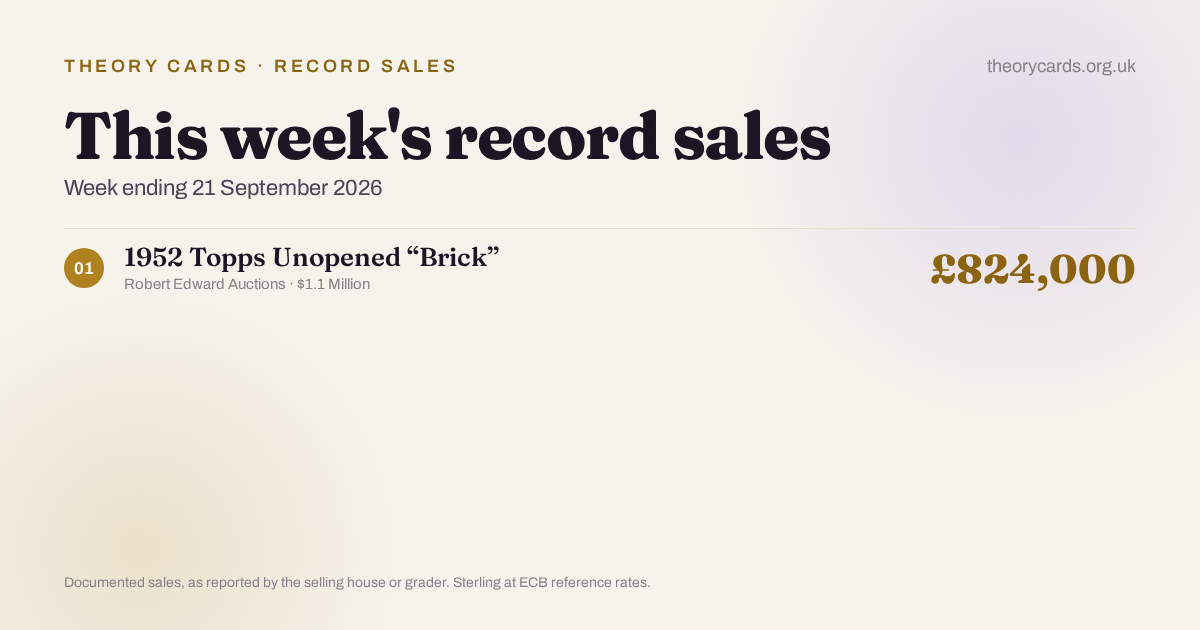
Robert Edward Auctions (REA) reported that its Summer Auction, which closed on 17 August 2026, was led by a sealed, unopened “brick” of 1952 Topps baseball cards. The lot realised £824,000 ($1.1 Million), according to the auction house’s own announcement, making it the standout result of the sale and, per REA’s characterisation, a record-setting figure for the event overall.
The 1952 Topps unopened brick
The headline lot was a sealed brick of 1952 Topps cards that had never been opened, meaning its contents remained unknown at the point of sale. REA reported the hammer figure as £824,000 ($1.1 Million). The auction house did not specify in its release whether this figure includes buyer’s premium, so no assumption is made here either way.
The 1952 Topps set is widely regarded as one of the most significant issues in the hobby, largely on the strength of its high-number series and its status as an early landmark for the modern trading card industry. Sealed, unopened material from this era is exceptionally scarce: most product from 1952 was distributed, opened and, in many cases, discarded or damaged over the following decades. A brick that has survived intact and unopened for more than seventy years represents a rare intersection of age, condition and mystery, since buyers are effectively purchasing an unknown assortment of cards rather than a single graded piece.
REA described this result as leading a “record-setting” summer auction, a characterisation attributed to the auction house itself rather than an independent verification. No further detail on the lot’s provenance, prior ownership, or the identity of the buyer was included in the reported material, and none is claimed here.
What it tells us
This week’s market news consists of a single documented sale, and it concerns a category, sealed, unopened vintage product, that operates somewhat differently to graded single cards. Because the contents of a brick are unknown at the point of sale, the price paid reflects a combination of historical scarcity, brand recognition of the 1952 Topps issue, and the speculative appeal of what might be inside, rather than a valuation of any specific card or grade. That makes it difficult to draw direct comparisons with single-card auction results, even ones involving the same set.
It is also worth noting that this result comes from one auction house’s own reporting of one lot. A single data point, however striking, does not establish a broader trend across the sealed-product market or across vintage cards generally. Readers should treat this as a record of what one specific brick achieved at one specific sale, attributed clearly to Robert Edward Auctions, rather than as evidence of where prices for comparable material stand more widely. As with any auction result, the figure reflects what one buyer was willing to pay on one day, under conditions not fully detailed in the available reporting.
Sterling converted from the reported figures at £1 = $1.33 (ECB reference rate, 2026-09-18) and rounded. Figures are as reported by the selling house or grader.